Coloreel Technology Explained: The Future of Thread Coloring in Embroidery
Explore how Coloreel creates embroidery colors on demand, where it adds value, and why digitizing, physical samples, and production planning still matter.
By I Love Digitizing 11 min read
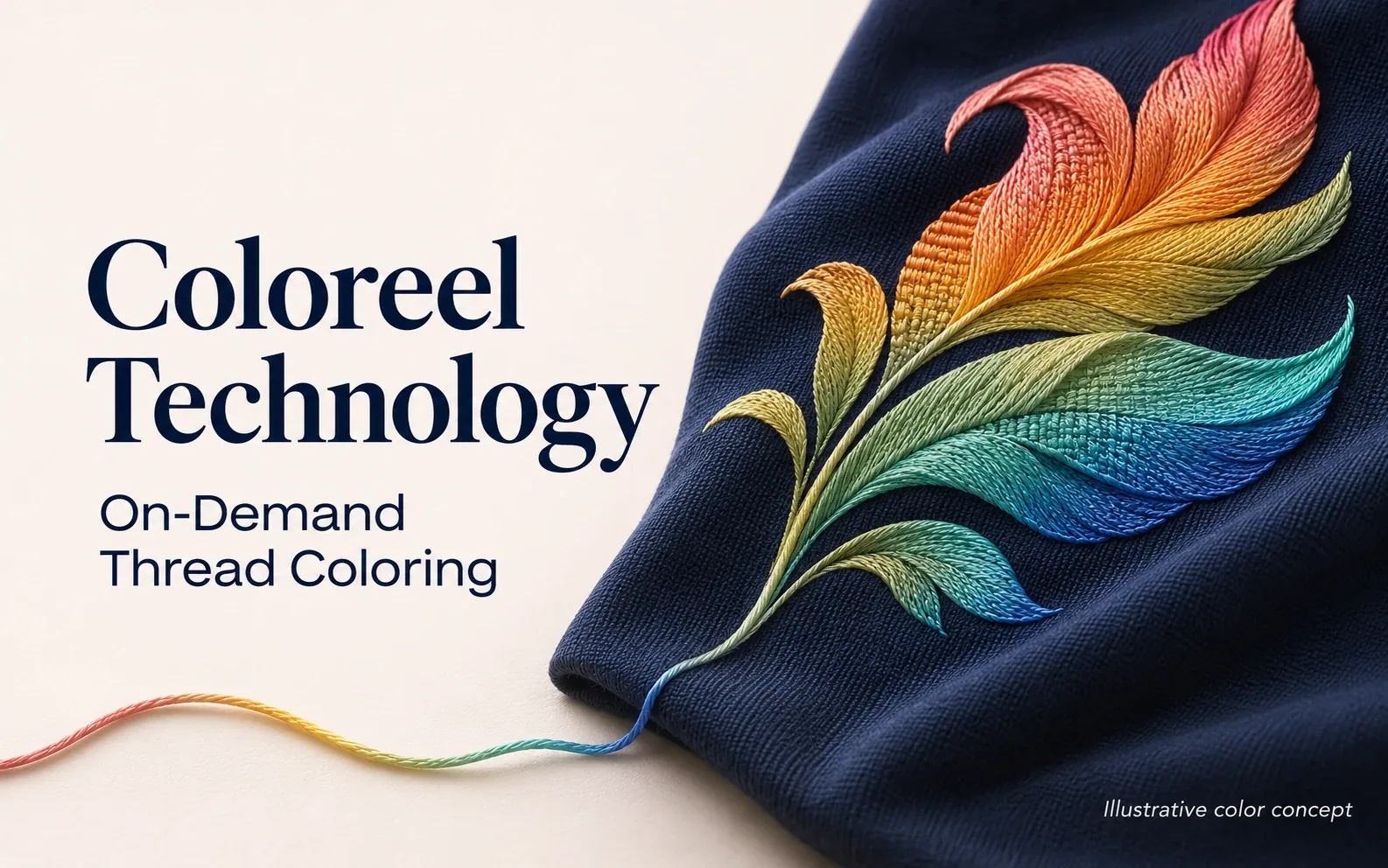
Imagine stitching a leaf that moves from deep green to golden yellow without loading a separate thread cone for every shade. Coloreel makes that kind of color planning possible by coloring embroidery thread as it travels toward the machine.
The idea changes an important part of embroidery production: instead of selecting every color from a shelf of pre-dyed cones, a producer can create color along a thread according to a digital design.
But what does that mean for an actual logo, patch, or garment? Does it make every job faster? Can it reproduce any brand color? And does it remove the need for professional digitizing?
This guide explains how Coloreel technology works, where it offers creative value, and the production questions worth asking before choosing it for a project.
What Is Coloreel Technology?
Coloreel is an on-demand embroidery-thread coloring system. Its Instant Thread Coloring Unit, or ITCU, colors a suitable white base thread before that thread is stitched into the fabric. Software coordinates the coloring with the embroidery design. 1, 2
The garment is still embroidered by an embroidery machine. Coloreel supplies colored thread; it does not replace the needle, hooping, stabilizer, or stitch formation.
This also distinguishes it from printing onto a completed embroidery. The color is applied to the thread before the thread becomes part of the stitched design.
The useful distinction: conventional embroidery selects a colored thread; Coloreel can change the color along a thread during production.
How Does Coloreel Work?
At a simplified level, the workflow has four parts:
- Prepare the stitch design. The embroidery needs a planned sequence, stitch structure, and suitable construction for its fabric and size.
- Plan the coloring. Coloreel-compatible software assigns colors and effects to the design.
- Color the thread. The ITCU applies color to the white base thread in coordination with production.
- Stitch and inspect. The embroidery machine forms the design, which must still be evaluated as a physical sample.
ZSK describes the system as coloring white thread according to the design before feeding it into the embroidery machine. Coloreel identifies CMYK as its coloring technology. 2, 3
The coordination matters. A color must reach the needle at the appropriate part of the stitch sequence. A gradient that looks attractive on a monitor is not enough if its transition arrives in the wrong part of a letter or petal.
Is It the Same as Variegated Thread?
Both can produce multiple colors along a thread, but they offer different kinds of control.
With ordinary variegated thread, the color sequence is already in the thread you buy. Coloreel plans coloring around digital production instructions. That makes design-linked color effects possible, although they remain subject to the system’s transition and synchronization limits.
It is better understood as controlled thread coloring than as simply a spool with more colors.
Coloreel vs. Conventional Embroidery
| Question | Conventional pre-dyed thread | Coloreel workflow |
|---|---|---|
| Where does color come from? | The selected thread cone | On-demand coloring of a suitable base thread |
| How are different colors organized? | Through thread selection and the machine’s needle/color sequence | Through a coordinated thread-coloring plan and stitch sequence |
| How can gradients be built? | By digitized blending or separate thread shades | By coloring transitions along the thread, combined with suitable stitches |
| Are specialty threads available? | A wide choice of materials and finishes | Approved base thread is used for the coloring process; conventional threads can be combined where supported |
| Does digitizing still matter? | Yes | Yes, with additional attention to color-transition placement |
| Is it automatically the cheaper option? | Depends on the job | Depends on the job, equipment, consumables, and workflow |
This is a workflow comparison, not a claim that one approach produces better embroidery in every situation. A simple two-color uniform logo and a gradient fashion motif have different requirements.
What Can You Create with Coloreel?
Gradients and Tonal Changes
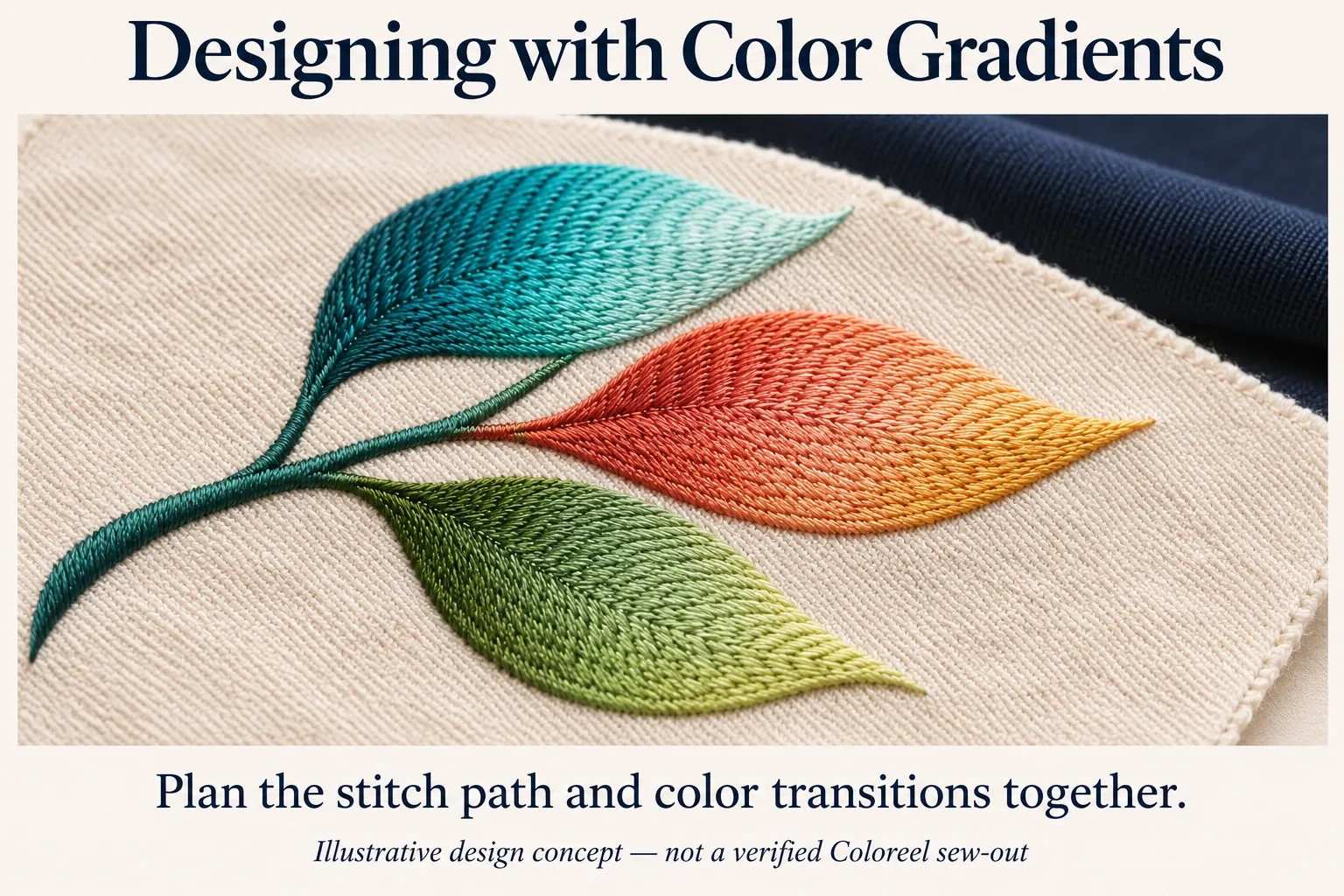
Gradient effects are a natural application: a large leaf, petal, wave, or abstract shape can move through related colors without assigning every shade to a separate cone.
Coloreel’s product materials describe gradient and other color effects as part of its digital coloring workflow. 1
For a first project, consider a broad shape with enough visual space to show the transition. A tiny detail may not communicate the effect clearly, even when it can be stitched.
Repeating Color Effects and Decorative Texture
Color can contribute to the rhythm of a design rather than simply fill separate objects. For example, an illustrative project brief could ask for a ribbon-like motif with repeated color changes across its surface.
The final appearance will also depend on stitch direction, length, spacing, and sequence. Color planning and stitch planning need to work together.
Alternative Colorways
A producer can explore different coloring plans for a suitable stitch design. That may help when comparing a warm palette with a cool palette or developing a range of coordinated products.
Treat each proposed colorway as a sample to approve. Changing color does not automatically confirm contrast, brand accuracy, or the appearance on a different garment.
Fashion Details, Patches, and Brand Projects
Possible applications include decorative apparel, statement patches, and branding that benefits from tonal variation. These are project ideas, not proof that every design or product is suitable.
For a brand with a strict flat-color logo, a conventional thread match may remain the more straightforward solution. The strongest application is the one where the coloring capability solves a real design or production problem.
Why Digitizing Is Still Essential
Coloreel changes thread management; it does not make stitch construction irrelevant.
The digitizer must still determine how the design will be formed and supported. For Coloreel, the stitch path must also accommodate where colors change. The manufacturer’s guidance describes planning a continuous sequence and using underlay to conceal appropriate transitions. 4
That does not mean every jump, trim, or tie-off can disappear. Travel between disconnected parts and the structural needs of the embroidery still have to be handled.
Color Changes Need Room
Coloreel calls an important part of this issue Color Change Precision, or CCP. Its support material explains that actual thread consumption varies and that the ITCU compares expected consumption with measured production information. Designers are asked to check the design’s robustness using the available CCP views. 5
The practical implication is to avoid treating a thread-color boundary like a perfectly fixed edge in vector artwork. A design may need a planned transition area rather than an abrupt change at a highly visible point.
Ask the producer to review small lettering, narrow outlines, short isolated sections, and sharp color boundaries before promising the original artwork can be reproduced unchanged.
A DST File Alone Is Not the Complete Coloring Workflow
Coloreel supports a workflow using ordinary DST stitch files with Coloreel Studio. Its support documentation also refers to DST and CSE files when discussing coordinated production. 4, 5
A standard DST does not, by itself, make an ordinary machine perform on-demand thread coloring. Confirm the file preparation, coloring data, software version, and machine setup the production partner requires.
Can Coloreel Match Any Color?
No practical color-production system should be assumed to reproduce every requested color exactly.
Coloreel’s own color-management guidance explains that screen RGB values and physical CMYK output are different. It also describes gamut: the range of colors a system can reproduce. 6
The company’s FAQ advertises more than 12 million colors, but that figure is not a guarantee that every Pantone reference, fluorescent shade, metallic effect, or monitor color can be matched. 3
For customer work:
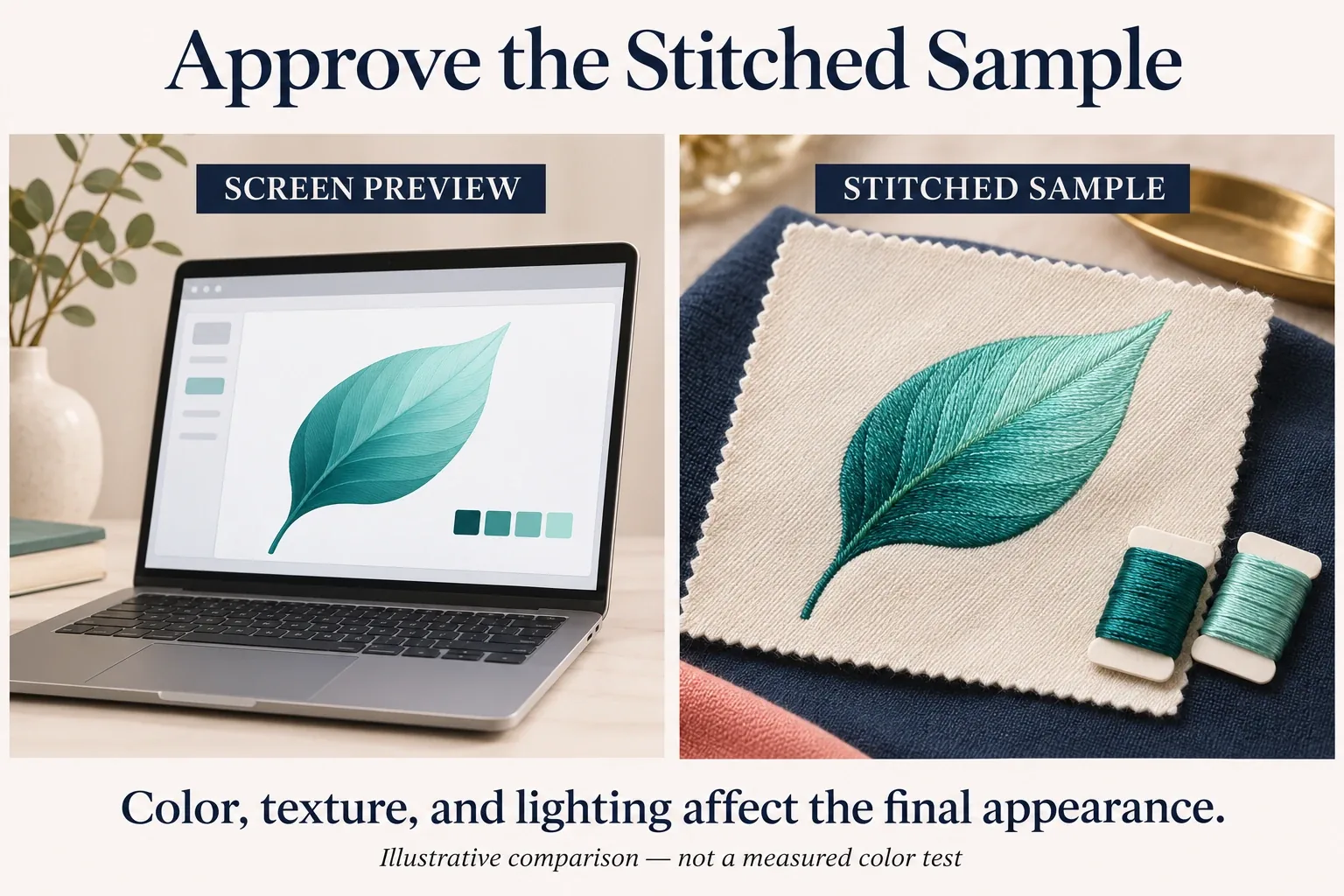
- Provide a clear color reference rather than relying on a phone screenshot.
- Ask whether the reference falls within the available gamut.
- Approve a stitched sample on the intended material.
- Check the sample in the lighting relevant to the finished product.
- Record the approved settings and sample for repeat orders.
These are approval steps, not a substitute for the producer’s color-management process.
Does Coloreel Replace Specialty Threads?
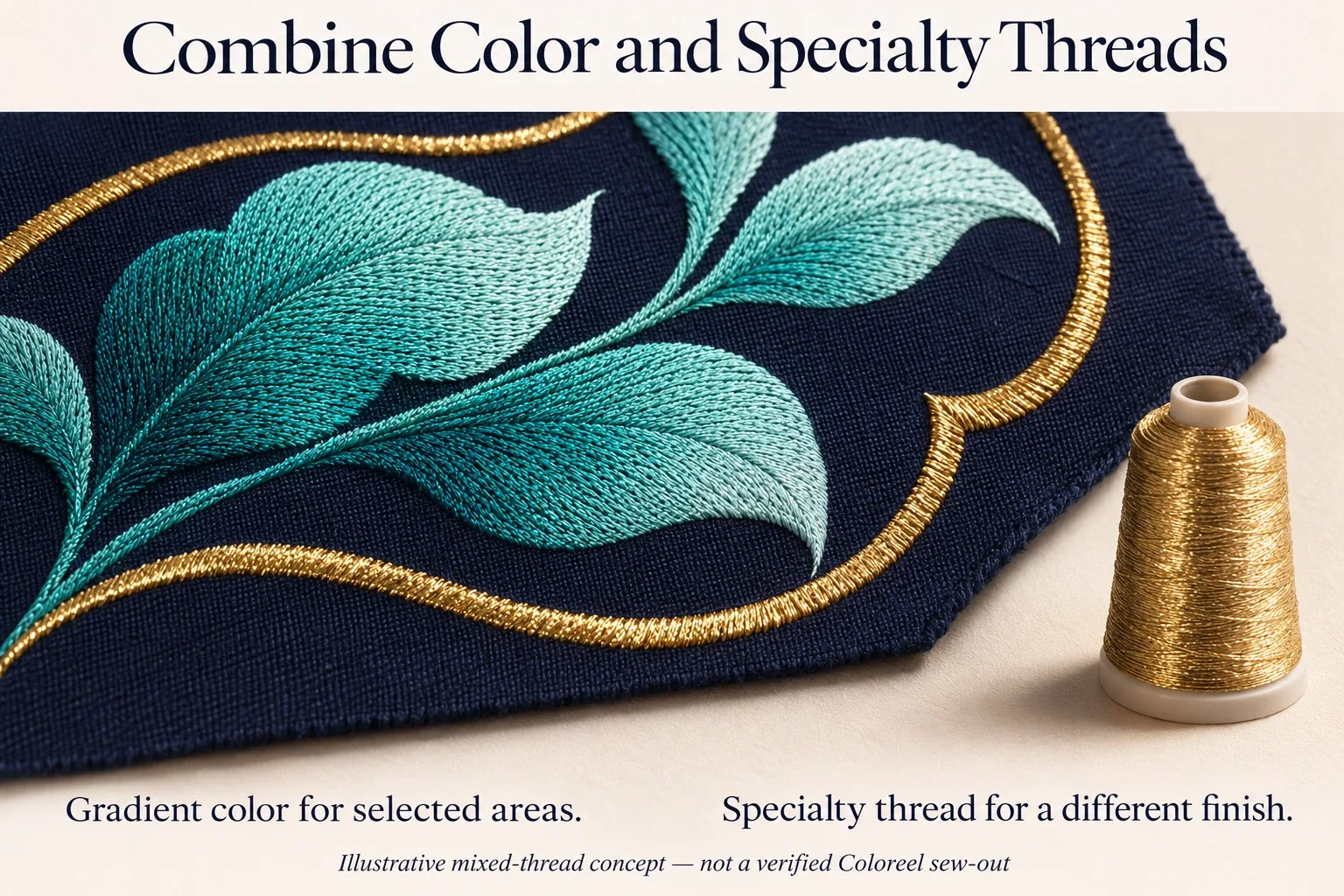
Not automatically. A printed color does not reproduce every physical property of a metallic, matte, neon, or other specialty thread.
Coloreel introduced a multi-thread option that allows conventional embroidery threads to be combined with its colored thread. The announcement specifically discusses specialty finishes and notes that ordinary thread can be cheaper for large plain white or black areas. 7
That makes a combined approach worth discussing. A design might use on-demand color for a gradient and conventional thread for another area or finish.
Confirm the current software and machine requirements with the producer. The existence of a multi-thread feature is not proof that every thread combination will work in every configuration.
Will It Make Embroidery Faster or Less Expensive?
It can reduce some color-related handling, but savings need to be measured against the actual job.
Fewer cone changes or color-related interruptions may help a complex design. However, total production still includes artwork preparation, sampling, hooping, stitch count, machine running time, finishing, maintenance, and any rework.
An appropriate evaluation compares two ways of producing the same acceptable result. Ask for:
- Setup and design-preparation time.
- Actual cycle time on a representative sample.
- Thread, ink, and other consumable costs.
- Maintenance, cleaning, and training requirements.
- Repeatability and rejected-piece rates.
- Local service and consumable availability.
Coloreel does not publish one universal equipment price in its FAQ; it says pricing varies by region and configuration. 3 Obtain a current written quote rather than building a business case around an old online price.
What About Sustainability?
On-demand coloring may reduce the need to hold separate stock of every thread shade. Coloreel also describes the use of recycled polyester thread and reports water savings against a specified conventional thread-dyeing comparison. 8
Keep the boundary of that claim clear. A thread-dyeing comparison does not establish the same reduction for an entire garment, factory, or embroidery order.
For a purchasing or marketing decision, request the underlying environmental declaration and check its functional unit, assumptions, date, and comparison process. Include consumables, energy use, maintenance, and your existing production method in the assessment.
“Uses on-demand thread coloring” is a useful factual description. “Makes every garment sustainable” is a much broader claim that would require additional evidence.
Where Does Coloreel Stand Today?
The technology has experienced changes in its commercial history. Coloreel announced that operations resumed under Coloreel International AB and new ownership in October 2024. 9
There is also more recent evidence of continuing development. In its May 2026 Texprocess report, Tajima described a live Coloreel demonstration and real-time communication with its TMEZ Series equipped with i-TM to coordinate thread coloring and thread control. 10
This supports discussing Coloreel as an active technology rather than relying only on its early launch announcements. It does not confirm that a particular configuration, integration, or service package is available in every country. Ask the supplier about the exact system being offered and its support arrangements.
Is Coloreel the Future of Embroidery?
It represents a useful direction for embroidery: closer coordination between digital color instructions, thread supply, and stitch production.
The most persuasive opportunities are projects where controlled color variation matters enough to justify the extra workflow. Conventional embroidery remains a practical choice for many flat-color logos, repeat uniform orders, and specialty-thread applications.
Our assessment is that the future is likely to include both approaches, with producers choosing the process that suits the design and business case. That is an editorial judgment, not a forecast of market adoption.
Frequently Asked Questions
Is Coloreel an Embroidery Machine?
It is a thread-coloring system used with embroidery equipment. The embroidery machine still forms the stitches in the fabric.
Can One Thread Produce Multiple Embroidery Colors?
Yes. The system colors different portions of a suitable base thread according to production instructions. Achieving the intended placement requires a coordinated design and setup.
Can I Use Any White Thread with Coloreel?
Do not assume so. The manufacturer identifies a specific Madeira 40-weight recycled polyester thread in its FAQ. Confirm current approved materials and consumables with the supplier. 3
Does Coloreel Eliminate All Thread Changes and Trims?
It can reduce changes made solely to select colors. Other trims or changes may remain necessary for construction, travel, or the use of conventional specialty threads.
Will a Coloreel Gradient Look Exactly Like the Artwork?
Not automatically. Printable gamut, stitch structure, thread consumption, fabric, and transition planning affect the result. Approve an actual sample before production.
Does Coloreel Remove the Need for Digitizing?
No. Stitch construction and sequencing still matter, with additional attention to color-transition management and the producer’s file workflow.
Start with a Design That Benefits from the Technology
Before choosing Coloreel for a job, identify what it should improve: a gradient, a controlled color effect, more flexible sampling, or a specific production task. Then ask the producer to demonstrate that result on the intended material.
For artwork preparation and stitch planning, explore I Love Digitizing’s embroidery digitizing service. If a project is intended for Coloreel production, identify that requirement at the enquiry stage and confirm the producer’s specialist workflow before placing the order.
Sources and Further Reading
- Coloreel, Products and technology
- ZSK, Coloreel
- Coloreel, FAQ
- Coloreel, For digitizers and designers
- Coloreel, Product updates and FAQ
- Coloreel, Color management
- Coloreel, Multi-thread option
- Coloreel, Sustainability
- Coloreel, Operations resume under new ownership, October 11, 2024
- Tajima, Texprocess 2026 exhibition report, May 20, 2026